




For US TikTok Shop sellers, Tapstitch, Printful and Printify are viable candidates when the seller’s shipping setup and selected products meet the current requirements. Tapstitch documents a direct US connection for domestically fulfilled products. Printful documents a Seller Shipping workflow and product-specific handling conditions. Printify provides a US integration with a TikTok-eligible product filter. The appropriate choice starts with an executable fulfillment configuration, then the apparel brief. A supported connection does not guarantee that every garment can meet every order deadline.
Which POD Platforms Are Viable for TikTok Shop US?
TikTok Shop US distinguishes Seller Shipping, TikTok Shipping and Fulfilled by TikTok. Access to a shipping method depends on the seller’s current account and the platform’s eligibility rules. A supplier workflow that requires it therefore depends on the option being available in the seller’s account. The supplier’s app page cannot grant that access. US shipping requirements
The current Fulfillment Policy measures dispatch against the applicable order deadline and qualifying logistics events. Uploading a tracking number is not equivalent to the parcel moving through the carrier network. TikTok describes a default handling-time range of one to two business days for regular orders, with separate conditions for eligible custom handling and Made-to-Order products. Dispatch is evaluated using the applicable deadline and qualifying logistics events. TikTok Shop Fulfillment Policy
Do not create a universal POD schedule from a supplier’s average production figure. The order type, handling configuration, production, handover and transit need to work together. TikTok’s current logistics guidance distinguishes regular orders from Made-to-Order and other handling arrangements. The seller must use the deadline attached to the actual order, including any applicable temporary extension. US logistics guidance
For a fashion seller, this changes the order of selection. A washed jacket may be attractive, but it is not a launch candidate for this workflow until its fulfillment origin and handling fit. A garment that works for a Shopify collection may have a different position in a US TikTok assortment.
Start with a launch plan containing the seller account, available shipping method, selected warehouse, product category and required handling. Then choose the garment and decoration. This plan should also define who monitors orders that do not import or enter production as expected.
The customer promise should reflect that operating plan. Separate an artwork or production step from transit, and identify what happens if a variant becomes unavailable. The brand’s videos may generate demand quickly, but the production configuration needs to remain reproducible as orders arrive.
Compare Connection and Publishing Requirements
A supplier comparison is more useful when it tests the same three things: whether the connection is supported, whether the exact product can use the required route, and whether the complete order process fits the deadline.
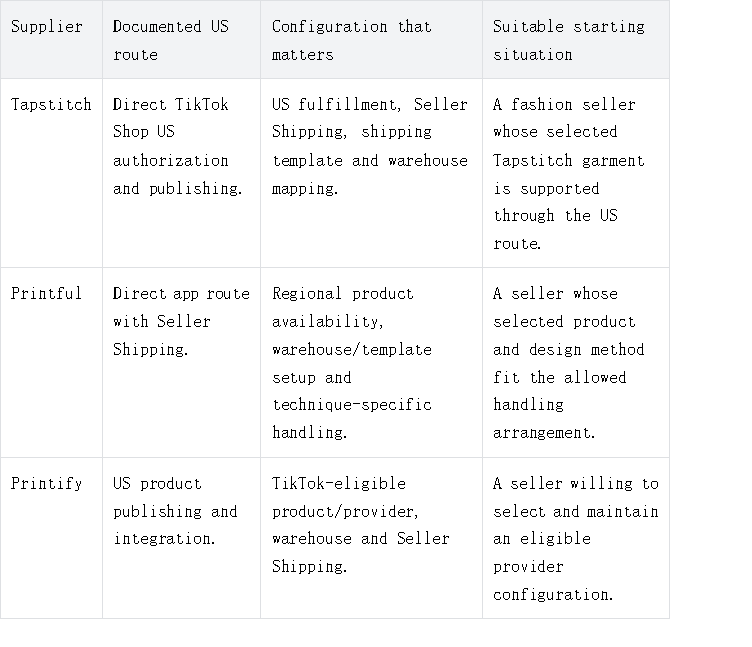
Sources: Tapstitch connection, Printful shipping setup, Printify product eligibility.
Seller eligibility and direct store connections
Tapstitch’s August 2026 connection guide describes authorization through TikTok Shop, direct product publishing and US-based fulfillment. Its current workflow should not be replaced by the older tutorial that routes through Shopify. For an eligible seller, a separate Shopify store is not the documented prerequisite for direct connection. Tapstitch current connection guide
Shipping settings and warehouse mapping
Tapstitch’s shipping guide adds warehouse mapping in its store publishing preferences. The TikTok warehouse must use Seller Shipping and the corresponding template. Mapping is an operating requirement, rather than a decorative account field: it determines which warehouse and shipping configuration a published product uses. Tapstitch shipping configuration
Printful documents warehouse creation, Seller Shipping and a published shipping template before products can be added. Its guide warns that, with multiple warehouses, the one returned first by TikTok’s API may be used. This makes the warehouse arrangement relevant for a seller combining suppliers, instead of assuming each app will use the seller’s preferred default. Printful TikTok shipping
Printify likewise requires Seller Shipping, a warehouse and a shipping template for its documented US route. Its publishing guide directs sellers to a TikTok-eligible product filter and a supported provider. These steps establish a configuration to evaluate; they do not establish that an unrelated catalog garment becomes eligible because the account is connected. Printify shipping setup, eligible products
For any of the three, authorization should be followed by a review of the actual published product, its warehouse and the order route. Treat those as distinct checks. A connected store can still have a shipping configuration that prevents an intended item from being published or imported.
Check Apparel Eligibility and the Whole Order Timeline
Build the timeline from the order events. A customer pays; the order becomes available to import; billing and approval allow production; the finished parcel is handed to a carrier; tracking progresses; delivery follows. Each stage can consume part of the available window. Looking at transit alone leaves out the earlier work.
Tapstitch’s order-sync guide identifies TikTok’s buyer-remorse period and states that its imported orders must use Seller Shipping. Its fulfillment guide recommends a stored payment card and automatic submission to reduce delay after import. Those settings improve the submission path, but should not be presented as a universal delivery guarantee. Tapstitch synchronization conditions, submission recommendations
Printful’s product guidance distinguishes techniques that fit its standard handling route from those requiring an eligible Made-to-Order setup, including new embroidery designs and certain all-over techniques. A seller without that eligibility should not assume those products can use the same handling as a standard printed tee. Printful technique and handling guide
Printify’s eligible filter helps identify relevant products and variants; its guide explains that non-eligible products can appear with a potential-delay status. This is a meaningful selection signal. A seller should not turn a publishable listing into a claim of satisfactory dispatch performance without examining its actual eligible configuration. Printify publishing conditions
The seller’s shipping template should also account for the supplier charge. Offering free shipping changes what the buyer sees, not whether production and transport cost money. Mixed baskets can make this harder if garments follow different routes. Price and customer messaging should reflect the intended product combination.
A paid evaluation order can expose an incorrect mapping or unwanted review delay before wider promotion. Record the import, acceptance, carrier handover and delivered parcel. The record should identify the exact variant and decoration. One successful order is useful operational evidence, while continuing monitoring is needed as volume and product mix change.
After the fulfillment route is viable, compare garments. Define the collection role: a roomy graphic tee, a hoodie or a more specific fashion piece. Use a product available through the supported route, rather than searching the full catalog and applying eligibility afterward.
Tapstitch’s US integration supports products fulfilled within the United States. Its custom-label and insert-card guides restrict those services to different routes or exclude US fulfillment. A seller should therefore build the US TikTok product around the branding that route supports, rather than combine international services with a domestic order promise. Tapstitch US scope, label restrictions, insert cards
Printful’s TikTok product guide filters availability to the store’s registered market. Printify’s product-provider eligibility serves a similar practical purpose for its US route. The relevant comparison is the resulting apparel shortlist, including its sizes, decoration and handling, rather than the platforms’ global assortment. Printful regional product scope, Printify eligibility
Maintain a short operating record for every listed product: its supplier variant, domestic fulfillment route, decoration, handling arrangement and shipping template. When a video begins generating orders, use that record to identify whether the sold product still matches the approved configuration. If a garment or route changes, reassess the deadline before continuing to accept the same promise. This is especially important for a fashion assortment where a visually similar replacement can differ in production requirements.
A supplier change should also trigger a review of the customer’s return route and the store’s instructions. The correct pickup arrangement does not automatically determine where a returned garment should go. Treat the complete purchase and after-sale path as part of the product launch.
Choose by the Requirements Your Shop Can Meet
Choose Tapstitch when a US-fulfilled garment meets the collection brief and the seller can complete Seller Shipping, template and warehouse mapping. Choose Printful when its regionally supported garment and technique fit the shop’s handling configuration. Choose Printify when the seller finds a suitable eligible product-provider combination and can maintain its shipping setup.
The seller remains responsible for its platform-facing product and delivery promise even when the supplier handles production and shipping.
If Seller Shipping is unavailable, or the required garment cannot meet the applicable route and handling conditions, these documented connections do not yet solve that shop’s problem. Resolve the operating configuration before advertising the product. The defensible recommendation is the supplier that can make the intended garment within a working US TikTok order plan, not the supplier with the largest integration logo.
FAQ
Connection paths and order deadlines need to be considered separately.
Do I need Shopify to connect every POD service to TikTok Shop?
The three services in this comparison document direct TikTok Shop connections for their supported setups. A Shopify store can be part of a wider channel strategy, but it is not a universal prerequisite for those direct routes. Choose the connection that matches the actual US seller account and follow its product, warehouse and shipping requirements rather than adding an unnecessary intermediary.
How should I plan a promotion when order demand is uncertain?
Start with a limited promotion and define when the team will reassess the order workload. Monitor unresolved orders and the time needed to review exceptions alongside new sales. If that workload exceeds what the team can handle, reduce promotion and resolve the bottleneck before expanding. Set this operating limit from the actual product route and available staff; do not present it as a universal supplier capacity or TikTok policy.