




Tapstitch, Apliiq and PODpartner provide different ways to produce custom streetwear for US customers. Their selected tees, hoodies, decoration methods and branding services illustrate how garment shape, washed finishes and fulfillment requirements influence the configuration of a small clothing collection.
Streetwear Production Options Across Three Platforms
A label reading “streetwear” does not settle a sourcing decision. A short, wide tee with a large back graphic is a different product from a long oversized tee with a small chest mark. A washed fleece hoodie is also different from a clean, dense cotton-face hoodie, even when both carry the same artwork. The practical comparison starts with those differences rather than a platform-wide quality ranking.
For a founder, the consequence is straightforward: decide which part of the product carries the design. If the blank’s shape and wash do most of the work, prioritize garment selection. If the inside label is essential, prioritize the identity service. If the graphic is the main event, compare the available canvas and decoration method.
A Shared Streetwear Production Brief
Use one tee and one hoodie as the comparison brief. For example, specify a loose tee with dropped shoulders, a substantial hoodie, a restrained palette, a back graphic, and an inside brand treatment. Treat these as design choices for this collection, rather than rules every streetwear brand must follow.
Write the tee’s chest width and body length as separate requirements. An oversized look can be broad, long, or both; a larger size of a conventional tee may alter the length without producing the shoulder line you want. For the hoodie, include the hood, pocket, and hem in the brief because they affect where artwork can sit and how the piece layers.
Separate essential features from preferences. Perhaps the back graphic must remain at its intended scale, while the wash can change. Perhaps a sewn label is essential, but an insert card is optional. That distinction makes a substitution honest: it shows whether a supplier fulfills the design or requires a different design.
Keep the comparison within each garment role. Compare tees with tees and hoodies with hoodies. GSM describes fabric mass per unit area, so it helps organize candidates; it does not combine fit, construction, decoration, and wearing experience into one quality score.
Garment Specifications and Production Options
The following named products provide a concrete starting set. Specifications are the sellers’ listed descriptions; the decision column explains how each affects the brief.
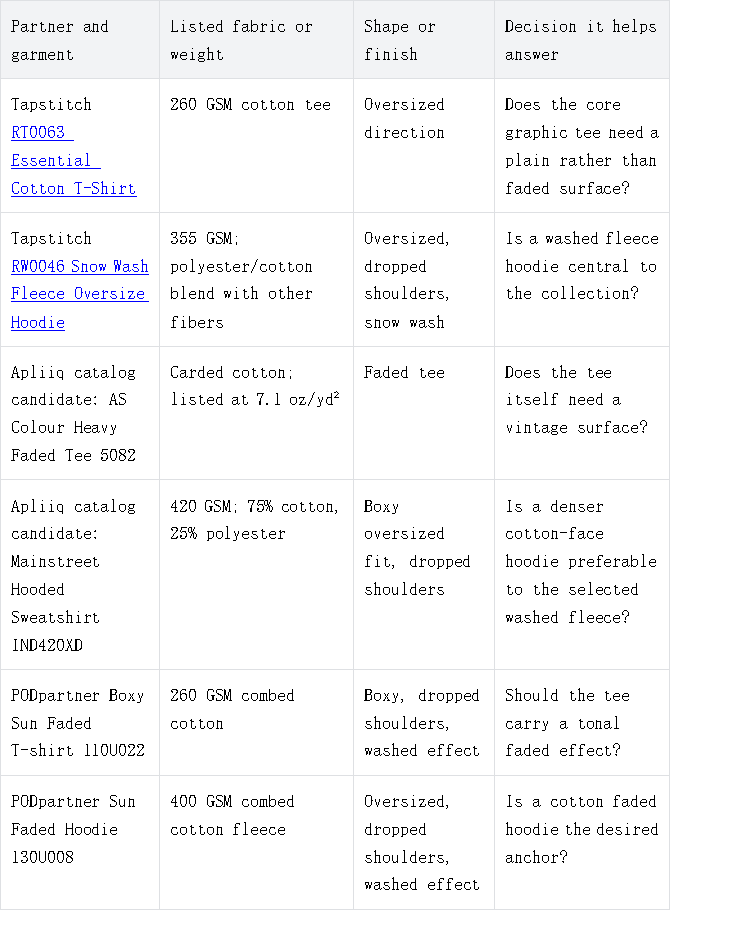
These candidates do not have identical finishes or fiber compositions. That is the useful finding: choosing a production partner also means choosing which version of the collection to make. A deliberate substitution can work, but it should preserve the features that make the product recognizable.
Fit, fabric weight, and wash
For a washed hoodie brief, RW0046 and 130U008 are closer starting points than a clean-surface garment. Their listed compositions still differ, so the heavier number does not automatically decide the choice. Apliiq’s IND420XD becomes a more relevant candidate when the priority shifts toward a boxy cotton-face fleece and the washed effect is negotiable.
PODpartner’s care guidance for 130U008 recommends hand washing and notes that its faded treatment can be less colorfast. That condition belongs in the product decision: the intended customer must be comfortable with the care required by the look. A finish that suits a photographed drop may be less suitable for a customer expecting simple everyday laundering.
Compare garment measurements across the sizes you plan to sell, including the smallest and largest sizes. Start with chest width, length, shoulder width, and sleeve length where supplied. Then order the size that represents the intended fit on your target wearer. A sample in an arbitrary size gives less useful information about the eventual product.
Print placements and brand details
The artwork can narrow the shortlist faster than fabric weight. The PODpartner 110U022 page lists front, back, sleeve, and inside-neck DTG areas, alongside HTV and embroidery routes. Apliiq’s 5082 listing separates transfer, digital print, screen print, and embroidery, with screen printing presented as a bulk-order route. Those are distinct production choices, rather than interchangeable ways to apply a file.
Design around the selected garment’s printable surface. A back graphic should relate to the garment’s width; a sleeve mark should remain readable when the arm bends. For a hoodie, leave room for the pocket, seams, and hood rather than sizing the image from a flat product mockup alone.
Brand identity requires a separate decision. Apliiq’s private-label service describes replacing the manufacturer’s tag with a sewn brand label on demand. Its woven-label service is a different route with a component minimum. Tapstitch’s labeling guide places custom labels within international fulfillment. Its homepage distinguishes available labels, hang tags, and inserts from branded packaging bags still in development. The label and the delivery route therefore need to be chosen together.
A useful artwork comparison uses two files: the exact design intended for sale and a simple placement reference showing its dimensions. Keep the reference out of the customer product, but use it to record how far the graphic sits from the collar or seam. If one garment requires reducing the image, write down that change before judging the supplier. Otherwise, a smaller image can make an unsuitable blank appear to meet the original brief.
For a coordinated tee and hoodie, decide which brand detail should repeat and which should vary. The same inside identity can hold the range together while the external artwork changes scale. Conversely, repeating an identical large graphic on both items may be intentional, but it does not solve a mismatch between their shapes. Approve the garments together, with the sleeve and hem proportions visible, rather than comparing isolated close-ups of the prints.
Order Commitments and Delivery Routes
A single garment order is useful when the design is still being resolved. Tapstitch has no minimum order quantity (no MOQ), so brands can order a single custom garment for evaluation. Apliiq’s sample guidance also permits ordering one designed product. PODpartner presents an on-demand streetwear route, while its pricing explanation separates garment, decoration, branding, and shipping charges.
The garment minimum and a trim purchase are different commitments. A founder can avoid buying a size run yet still purchase branding materials or pay artwork setup charges. Put those commitments beside the trial configuration so the decision reflects the finished product, not a blank’s advertised entry price.
For a US buyer, distinguish the destination from the production location. Tapstitch’s international labeling condition matters if the label is part of the retail promise. Apliiq presents US production locations through its private-label offer. PODpartner publishes destination-based shipping information. None of those facts makes one transit estimate applicable to every item and service.
Plan the customer delivery window around the complete sequence: order submission, production or preparation, carrier handoff, and transit. A branded sample should follow the route intended for customer orders, because a convenient unbranded purchase may bypass the step that actually determines launch readiness.
Production Options for Different Streetwear Priorities
If a washed oversized fleece is the collection’s defining feature, begin with Tapstitch RW0046 and PODpartner 130U008. Compare the blend, cotton preference, silhouette, and care expectations. Choose the garment that serves the product idea; do not change the idea simply to follow a heavier GSM figure.
If a sewn inside identity carries the brand, start with Apliiq’s private-label route and a compatible blank. Its distinction between on-demand private labels and stocked woven labels helps a founder choose how much trim commitment to take on. Tapstitch remains a candidate when its international label route fits the delivery plan.
If the artwork carries the collection, shortlist the products whose decoration areas preserve its scale and placement. Trial the finished graphic, label, and garment together. When two candidates meet the essential features, use the complete order cost and customer route as the deciding factors.