




Tapstitch, Printful, Printify and Apliiq support different approaches to building a custom clothing range for US customers. Their garment, decoration, labeling and packaging options show how a brand’s visual direction connects with product selection, production configuration and customer delivery.
For starting a fashion brand, Tapstitch, Printful, Printify and Apliiq suit different versions of the same task: turning selected garments into a collection customers can recognize and reorder. Tapstitch is a candidate when its specific silhouettes and finishes define the range. Printful deserves consideration for a collection using its documented garment and decoration options. Printify fits a founder prepared to manage product and provider choices. Apliiq warrants attention when sewn labels and supplied packaging are important. The supplier decision should follow the complete collection, rather than the presence of a logo service.
Supplier Capabilities for Different Brand Requirements
The garment brief should decide which supplier remains on the shortlist. If a washed body is central to the identity, a named washed garment matters more than a large library of mockups. If the interior mark is central, the label method and its fulfillment conditions become part of the garment selection. If the range will use several production providers, product records need enough detail to keep reorders consistent.
For a new brand, shortlist a representative product before committing the whole collection. A supplier earns its place when that product carries the intended fit, artwork and identity without requiring the brand to promise features unavailable on its chosen route. This creates a practical choice among the four platforms while leaving room for different suppliers to suit different collections.
A Shared Clothing Brand Brief
A collection needs a reason for its pieces to belong together. That reason might be an illustration style, a recurring proportion, a color family or a particular use. A graphic merchandise line can have a clear identity, just as a collection built around silhouettes can. The difference is what the founder must preserve when moving between garments.
Use a three-piece brief: a roomy graphic tee, a coordinating sweatshirt and a second tee with a different finish. This is an illustrative design assignment. The first tee introduces the visual identity, the sweatshirt extends it into another season, and the second tee provides a variation without changing the audience. Each product needs a defined role before it needs a supplier.
Fit is part of that role. A cropped, wide tee and a long, narrow sweatshirt may be attractive individually but difficult to sell as the intended outfit. Fabric and finish add another layer. A faded surface can be central to the visual concept, while a clean surface can suit the same artwork differently. Neither is automatically a higher-quality brand choice.
Brand touches should then reinforce the garments. Interior labeling can help identify the product; a card can explain care or the collection story; packaging can organize the arrival. Those details do not compensate for the wrong body or an inaccurate listing. The collection should remain recognizable even before the customer opens its card.
Consistency also needs an operating definition. It can mean repeated measurements, a dependable garment model, coordinated colors or the same artwork treatment. It need not mean that every fabric is identical. A founder should decide which differences are intentional and which would disappoint a repeat customer.
This leads to a more useful supplier comparison. Instead of asking which platform can “make a brand,” ask which one can support the intended garments, design expression and repeatable customer experience. Some collections can work through several suppliers. Others depend on a particular catalog product or branding service.
Garment and Branding Options Across Four Suppliers
The four suppliers should face the same brief, while the selected products remain clearly identified. A label added to one garment should not become a claim about an entire catalog.
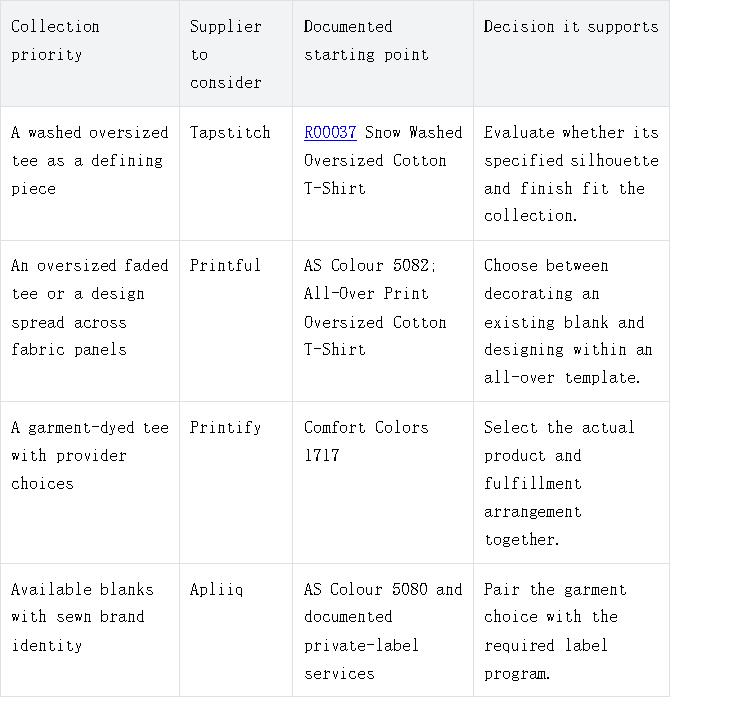
Fit, fabric, and wash across styles
The table shows why a platform-level adjective is an inadequate selection rule. Tapstitch’s snow-washed tee, Printful’s faded oversized blank and Printify’s garment-dyed relaxed tee offer different interpretations of a casual graphic product. Apliiq’s listed heavyweight oversized blank provides another starting point. The founder needs the one that suits the desired body and surface, not a generic “fashion” designation.
For the roomy tee, write down target chest width, body length and sleeve proportion. Use the same measurement points when reviewing size charts. A size letter is not a common unit across different blanks. The selected medium on one garment may have a different role from the medium on another. That affects photography, fit guidance and how customers choose their size.
Fabric specifications help narrow the shortlist, but do not establish the complete experience. Tapstitch lists its R00037 at 250 GSM; Printful lists its all-over cotton tee at 300 GSM with cotton and elastane. These facts describe different constructions and design routes. They do not establish which sample feels better, washes better or suits every climate.
Treat a listed washed or garment-dyed finish as a product attribute to incorporate into the artwork. The graphic should make sense on the chosen background. A fine illustration and a deliberately faded body might require different contrast from the same illustration on a clean white tee. Keep the image file consistent for comparison, then make purposeful changes for the final product.
A finished sample should settle the questions the page cannot: how the garment sits on the intended wearer, how the print interacts with its surface and whether the care result is acceptable. Sample approval belongs to a specific garment and design. It should not become an endorsement of every product carrying the supplier’s name.
Labels, packaging, and consistent brand details
Choose the decoration by what the design requires. An existing blank with a front illustration is a different project from a pattern spread across cut fabric panels. Printful’s all-over cotton route prints the fabric before it is cut and sewn to its offered pattern. That provides another visual option, while remaining distinct from commissioning a new pattern.
Embroidery also needs a specific configuration. Tapstitch’s current embroidery tool supports text on compatible garments, rather than uploaded artwork. A collection built around an embroidered illustrated logo needs a different supported route. A platform’s ability to produce a printed illustration does not establish its ability to embroider the same file.
For interior identity, compare methods rather than grouping everything under private label. Printful documents inside-label printing for eligible tear-away-label products. Printify documents labels through supporting providers. Apliiq separates no-minimum private labels from woven-label inventory, with a 100-label minimum for woven labels. The inventory concerns labels, not 100 finished garments.
Parcel details introduce fulfillment restrictions. Tapstitch’s insert-card guide excludes US-fulfilled orders. Printful’s supplied pack-ins must be held at the facility fulfilling the order. Apliiq also links supplied inserts to stock at the relevant warehouse. These arrangements require different preparation, even when the final customer sees a similar thank-you card.
The brand should identify essential touches and optional ones. If a custom interior mark is central to every product, select garments supporting it before approving the assortment. If the card is optional, it can be introduced later without changing the clothing itself. This keeps the launch focused without confusing a simplified first release with a complete future brand program.
Keeping the range consistent as it grows
A coherent assortment is a product-management task. Create a record for each piece containing its supplier, model, selected colors, size chart, decoration and branding configuration. For Printify, include the selected provider or fulfillment option. A shared graphic file is not enough to identify a reproducible product.
Color needs particular attention. An identically named color across a tee and sweatshirt is not evidence that the finished garments match. Approve the intended pair together and photograph that pair. If the range deliberately mixes tones, show the difference clearly rather than describing them as a matched set.
The same applies to substitutions. A replacement blank might solve a stock problem while changing the collection’s proportions or label options. Decide in advance whether such a change is acceptable. If it changes an essential attribute, treat it as a revised product that needs approval and updated customer information.
Branding consistency should include what happens when pieces ship separately. A supplier’s ability to include a card in one parcel does not establish that every parcel follows the same route. The operational question is which customer experience the brand can reliably advertise for each product combination.
Supplier Options for Different Brand Priorities
Tapstitch is a suitable candidate when its specific washed, oversized or other named garments are the foundation of the collection and their fulfillment conditions fit the brand. Printful is worth choosing when its offered blanks or all-over design route match the visual plan and the required branding is supported. Neither recommendation requires calling another supplier’s garments inferior.
Printify is suitable when the founder wants to evaluate available blanks and providers as part of the collection build. Its advantage for that founder is the ability to make a deliberate configuration choice; the corresponding responsibility is maintaining that choice and understanding changes. Apliiq deserves consideration when sewn identity and supplied packaging are important enough to justify managing their preparation and stock.
For a first release, approve a representative finished garment before expanding the assortment. Then approve the pieces together, including any essential labels and parcel details. The supplier that makes those decisions workable is the appropriate starting partner. A clothing brand becomes coherent through its product choices and execution, rather than through the name of the platform that prints it.